

Leave a Comment:
136 comments

Good news for all Minibond holders:
http://www.martinlee.sg/minibond-holders-to-get-partial-refund/
Reply
Hi Lioninvestor
noted that the last message (above) was posted on 24.july 09.
kindly advise if you have any further update on the minibond saga to share with us please?
ReplyHi Larry,
The latest was the gathering organised by Tan Kin Lian last Saturday at Hong Lim Park.
Other than the individual settlements, nothing much is happening on the local scene.
More significant events have occurred in Hong Kong, where the financial institutions have been ordered to do a mandatory buyback of the Minibond from all their customers.
Reply
Hi Lioninvestor
They did compensate me a little , but I was made to sign the non-disclosure letter which prevents me from discussing it.
ReplyI had only lodged a misselling complaint to the banks (where I bought mini bonds from) 4 weeks ago. They called me and said that they have reached a decision on my case and invited me to go down to discuss it. They also asked me to bring my CDP statement to proof I have minibonds in my holdings. Is this good news does this mean that I will be given some form of compensation. I mean they won’t ask me to come down just to tell me my claim has been rejected right.
Reply
Hi, can anyone advice on the following?
I’ve bought Minibond series 2 which is backed by the synthetic notes from GM. Now GM is bankrupted, does that mean the minibond is worthless?
ReplyHi Tham,
It’s backed by synthetic portfolio notes issued by Beryl Finance limited, which are in turn secured by floating rate notes due 2012 issued by GE Capital Corporation, not GM.
Reply
Hi,
I was informed about this website by my friend and I saw your update till 2008.
So far, is there any update on progress of the Lehman minbond ???
I still holding on the series 3. Any advise how to get redress ?
Thank you,
Steven
Hi Steven,
There hasn’t been much news recently.
If you have yet to seek redress, you can follow the steps prescribed by MAS, ie
file a case with the Financial Institution. Escalate to FIDRec or legal action if resolution is not satisfactory.
ReplyHi Collin,
there were many cases that were settled for x% of the original.
Getting back x% is still better than getting back nothing.
Reply
Thanks for the advise.
My dad actually co-share the investment with his brother but they both are not internet savvy to file the complaint with FIDReC. Do you have any idea how they should go about doing it the physical way instead of using Internet? (Go to Hong Leong headquarter directly and file a complaint then go to FIDReC?)
Thank you.
ReplyHi Collin,
You can refer to my previous post:
http://www.martinlee.sg/how-to-file-a-dispute-for-structured-product-victims/
Reply
Hi depressed:
I am not sure if you are going to get much update specific to a certain series. You might want to check out some of the seminars and talk to some of the people there for exchange of information:
http://minibondsg.blogspot.com/
5D
Reply
please tell me any news for lehman minibonds series 1 now? from depressed
Reply
If one gets compensated and then sign a non-declaration form i.e. not to talk about it, then how will you be able to know who got compensated?
As like I say previously, go through the motion and hope DBS High Notes and Jubilee notes people succeed in their FIDReC claims or class action. Also lets hope Hong Kong Govt and banks Notes buyback effort can reached a high % return so that Sgp can follows.
No top support, so what kind of result will you be expecting from FI and FIDReC? We are fighting a lossing game.
Hope on Saturday, Mr Tan Kian Lian can update us some good news.
Cheers
Reply
I wonder if you guys know about this discussion http://forums.delphiforums.com/sisualai/start
Reply
Very good observation, Aaron. What would be the view of MAS? Buyers be Aware, of course.
Here is the MAS dilemma:
Up to now, MAS is using that to say nothing is wrong [except if you are over 62, under Primary education type stuffs] hence investors who felt deceived should just blame themselves.
Then, later on, if MAS tighten up the regulation on these structured products – it would be an admission that something was not right. Remember even Alan Greenspan ready admits making mistake, our MAS did not – not sure if MAS does not make mistake or not admitting.
Let’s assume MAS tightens this up in the future, how would I as a MiniBond victim feel? Surprise, I actually feel worse: First, I got screwed by the bank; then, I got screwed by MAS.
I just don’t want to be screwed twice!


From what has happened during the last few weeks, it looks like many of our FIs are involved in the sale of structured products, either as issuer and/or distributors. All these products have almost the same features, a basket of underlying securities as a backup for the Credit Default Swaps of 7 entities. Those 7 entities are smoke screen to mislead investors on the safety of the structured products. What is most shocking is that most of the underlying securities consists of CDO, options, securities, etc. In conclusion, these structured products are very high risk products with a low return.
Our government always caution our citizens to be cautions of our money and to avoid investing in high risk products.
Now, so many of our FIs are throwing so much complex deriviatives to our citizens for the last few years and MAS allowed such sales to go through. There is a very big contradictions here.

Could you also kindly give an explanation in the layman terms for DBS High Notes 2?
Where can we find the pricing statement and prospectus of DBS High Notes 2?
Many thanks.
Hi LK,
You can download the pricing statement of the High Notes 2 from here:
http://comment.straitstimes.com/showthread.php?t=13637&page=17
The HN2 is structured similarly to Minibond. You might also want to read the comments by Del Boy here:
http://www.martinlee.sg/dbs-high-notes-5-liquidation-value/#comment-4007
Reply
Anyone heard or saw any news on Minibond Series 7 and 8. It passed 15 days from the day due for interest payment. Did it defaulted?
ReplyThank you very much for the yield analysis, Del Boy. Based on the discussions here as well as talking to people in this industry, here is my conclusion in simple English:
Had the MiniBond product been structured as an “AA Bond Fund”, the yield might have been higher and the risk a lot lower (i.e. no first to default landmine as well as this no more than 12 entities in the basket defaulting stuffs”.
But then, investors would get a lot more suspicious especially the underlying securities are not to be disclosed. By adding the 6 reference entity credit default swap, it accomplishes the deception of shifting attention to the 6 entities as well as making more money for Lehman. Last but not least, the product is structured in such as way that it is designed to suck money from fixed depositors.
Some banks don’t sell this. Could it be because they see that this product fails the “suitability” test for retail depositors? Yet, they are being penalized for making less profit when the aggressive banks who were greedy about commission just sell, sell, sell and now they are protected by Buyers be Aware.
5D
P.S. Reply to Ryan: there is a youtube video link posted in this site a few days ago on what to do at interviews. They are in Cantonese and only take 10 min each – find a friend who knows Cantonese if necessary.
Reply
Yes, with a clearer understanding now, my view is that the “reference entities” are just smoke screen to divert attention from “underlying securities”, i.e. the toxic CDO.
The real objective is to dispose off the CDO, which they (Lehman Brothers) know is a time bomb.
If without the “reference entities”, investors will sure ask what the “underlying securities” are?
Hope that US authorities probe further and charge those involved in Court, and let the world know the truth.
Reply
hi
I have file a copmlain with the FI on behalf of my parents. Can any kind soul please advise me what should we do or what should we be looking out for if we are being called up for interview. From some of the msg I have read, it seems that we are so defenceless against the interviewers. Typically, they will try to catch my parents words and shun away from responsibilities.. how can we better prepared?
ryan
Reply
hi ryan,
interview conducted by ocbc sec and dmg was ok – not sure about the other FIs.
basically, they want to hear from the affected investor on the process of how he/she bought the toxic product – from initial knowledge of product till signing of forms and after.
for details that are lost in memory, it is ok to tell them that you don’t remember.

Globalisation, sub-prime crisis, future of USD etc.
This economist gave this presentation aound Feb-08. He presented the making of the current financial crisis in an easy to understand manner, drawing on the cultural differences between East and West, how the East was exploited by the West etc. THE GLOBAL ISSUES AS PRESENTED BY AN INDIAN ECONOMIST. It is quite scary.
http://video.google.com/videoplay?docid=4343898391323537541
-VSL
ReplyPls look at today’s Straits Times, There is a 1-pg article on what PM says about this debacle. He supports MAS position wholesale. Basically, MAS has not and will not vet such products in future. It appears that no organisation in sg is going to do this job of ascertaining the merits/demerits of CLS. The onus lies on the investor. I have written off sg banks for all financial activities, except for plain vanilla savings/FD a/c.
I am very sad at this state of affairs. AVA is doing a fine job of vetting food products/medicines etc before allowing them into sg. Why can’t MAS (or some other newly formed govt body) take on this role for financial products?
-VSL
Reply
5D, Sorry for the late reply. Back in 2006, perception of credit risks (i.e. defaults) was very low. Lets take a classic example, AIG. It was trading at 15bps for 5yr. i.e. in the CDS contract, protection buyer (the one being insured) will pay to the protection seller (the one providing insurance) 0.15% p.a. calculated on a notional of say US$10mm for 5yr. If I recalled correctly, the rest of the names you see in Minibonds are paying between 25bps – 50bps each. The pricing of the AA tranche CDO is not exactly a rocket science, but it is beyond the scope of our discussions. There are however a couple of general rules like “thickness” of the tranche, level of subordination, notional amount of the entire portfolio that dictate the return.
It is all a bit academic now. The financial markets in Singapore and other places will be changed forever and it is impossible to imagine that theses products will be ever offered to retail investors ever again.
Things are moving in the right direction though. There are news everyday regarding Minibonds and High Notes. It is important NOT to be left out of any compensation exercise. It is absolutely ridiculous to suggest that the better educated and income generating investors should be compensate less. Does not make sense ! If you don’t cry, you don’t get your money back ?
Let me give an excellent example here. I was reading the Strait Times over the weekend. I was shock to hear some of the so-called Professors of certain esteem institutions here trying explain their understanding of how these products work. I’m afraid to say that these Professor got it wrong too, having spent reasonable amount of time reading the relevant documents. If a Professor got it wrong AFTER THE EVENT, what hope do anyone of you have before everything gone pear shape ? Perhaps, these Professors are not that educated after all !
Reply
Hi Del Boy, I have also read the Sunday Times about the structured products written by some so-called Professors, but due to my education standard (only sec 2), I only half understand. Can you please highlight which parts that the Professor got it wrong? so that I can have more understanding. Thank you.
ReplyFury, it is not what you are, it is who you are that counts. Sec 2 or not, I’m sure you are just a decent individual who earn your living the hard way.
Anyway, I don’t have the paper anymore. My dog probably did a mojo on it. Among other things, I think the good professor said was the 110 of underlying bonds. They are not bonds, there are no bonds. These are what we called “synthetic” securities that look and smell like a bond. These are 110 CDS derivative contracts, just like those that representing the RFs in the minibonds.
Nothing against the good professor, who probably did the piece with good intentions.
My point is this – it is NOT about education.
If I said to you less than 50 people in the entire Singapore who understand these things completely, would you believe me ?
ReplyI think where the $50K limit came about was when Fedric was established in 2003, it was agreed by the FI that their award limit is $50K. Unless the FIs came out and say they agree to a higher limit, the AWARD limit should still be $50K. I think what MAS said is if you loss from than $50K, you can still go thru that channel implying that you understand your award is max at $50K. So, if you losed $200K and you don’t mind your award is max out at $50K, you can go thru that channel. I think that is why people are resorting to lawyers also.
ReplyFrom MAS
“FIDReC normally deals with claims not exceeding S$50,000. In the case of the three structured products, however, the FIs have agreed for FIDReC to hear deserving cases with claims exceeding this amount.”
ReplyThis is very good clarification.
Anyone who has invested more than $50K and has gone thru the complaint to FI/Fedric process please share your experience with us.
Thanks.
Reply
Hi LionInvestor and All, we were told that Fidrec only handle up to $50K dispute, but I believed most of us have more than $50K investment. So I was wondering is the $50K refer to all the investment with that bank or is refering to every transaction. For my case, I spread my investment accross a no. of series and product such as Jubilee, Minibond and Pinnacle with no more than $50K per transaction. Does any body have a clue?
Rgds,
ReplyHi CB,
MAS has mentioned that for this special situation, the $50k limit will not apply. FIDREC will look at all cases.
Reply
I heard that even if FIDREC will look at cases above $50,000, the compensation amount (if you win the case) is still limited to $50,000 ?? Can anyone confirm this ?
ReplyQuite clear that this is a special case. The $50k should not apply.
http://www.mas.gov.sg/consumer/structured_products/faqs.html
“FIDReC normally deals with claims not exceeding S$50,000. In the case of the three structured products, however, the FIs have agreed for FIDReC to hear deserving cases with claims exceeding this amount.”
Reply
Hi,
Let not over-react. For GE Choice (Aug 2013)
There are 2 defaults from Fannie Mae and Lehman Brothers out of the 119 companies. This results in a loss of -1.71% reducing the loss protection level to 10.33% and the Tranche Rating from ‘AA’ to ‘BBB’.
It should be able to take about another 10 defaults. The current low indicative price of $0.244 is a indication of the decline of market confidence but does not mean a loss of principle.
When you see the protection level goes down to 5%, you can start panicking. GE Choice is not first-to-default like Minibond or DBS high notes 5. So it is safer, until GE goes bust.
When you see the protection level goes down to 0%, it is almost certain the principle is gone.
You can see the latest fund report from
http://www.lifeisgreat.com.sg/en/jsp/products/products/investment/fundreport.jsp
Sorry. it should be a loss of 1.17% instead of 1.71%. The initial protection level during launch is 11.00%. There was a earlier gain of 0.50%, so the cumulative net loss is 0.67%.
ReplyGE Choice (Aug 2013) as of 31Oct
Current Unit price: $0.206
Number of Default: 4
1. Fannie Mae (US)
2. Lehman Bothers (US)
3. Landsbanki Islands (Iceland)
4. Kaupthing Banki (Iceland)
Initial protection level: 11.00%
Cumulative loss: – 2.45%
Cumulative gain: + 0.50%
Current protection level: 9.05%
Another 5 defaults should bring protection level down to 5.00%.
However next few months of the 2008 should be less dramatic than last Sep & Oct. Also the current unit price is only 20% of the initial unit price.
There is no point redeeming.


A general question – were you aware of the complex arrangment between GE and Goldman Sachs for the GE Choice Fund when you made your investment ?
Reply
i was only aware that it will take abt 13 defaults (which I think was quite safe then) before I will lose my principle. This was explained by my agent.
However, when reading the footnotes, i realized it’s not just 13 credit events, if issuer or swap counter party default, it will be affected too. Is issuer signum platinum? And who’s the swap counter party? What’s the role of GE here?
Can someone enlighten? It’s really complex, when i bought it at that time, I also thought it was quite a safe investment since interest is not that high..
ReplyThank you so much for the great insights, Del Boy.
That is very insightful. It also shows how smart is Lehman also. If I were going to structure it, I probably would use Merlion and Mount Faber as reference entity and got nothing in return as insurance:-)
However, had it been structured that way, it would have been just like a semi-junk (AA) bond fund and it would not have been that bad after all. And, I think between what the AA basket can yield vs. what the investors are getting there is enough of a spread for Lehman and the banks to make money.
The AA rated CDO yields you were referred to, which you wrote 0.75%-0.85% – how is that being measured? My guess would be the AA basket probably yields say around 8% per annum.
And, what about the insurance part of 0.45% – 0.50% your quoted?
You are so right on the risk beyond just the 6 or so of reference entities. If there are 11 (or so) or more of the say 200 underlying securities in the basket goes belly up, the investor risk losing the everything again? With the way the finanical/stock market is going these days, the odds of hitting 11 out of 200 goes up as time goes by.
Thanks,
5D
ReplyThere is old Chinese saying “hanging a sheep head to sell dog meat”. There is no better way to describe these Minibonds and (especially) High Notes
Selling first to default baskets (i.e. the Minibonds and High Notes) to retail investors in itself does not make a huge fortune for Lehman, DBS and the likes. But what it does do is to provide a channel for them to sell CDO products. HK and Singapore together accounted for US$2 billion worth of Minibonds. Contrary to popular believe & description, Lehman was not a bank. In essence, Lehman was a gigantic betting shop. This business is all about leverage. Here is the clever part – that US$2 billion real cash collected from investors can be easily leveraged into US$20 billion (10x) or more.
CDOs as underlying securities contributed greatly to the yield of the entire structure. The AA rated CDO would probably paid 0.75%-0.85% in those days. The typical 1st to default basket you see in Minibonds and High Notes are made up of nearly 100% financial institutions (with the exception of Singtel). The total return of such 1st to default basket of 6 RFs is usually calculated as the credit spread of the worst name within that basket (it is a game of probability). It is not priced as the sum of all the credit spreads in that basket. Looking at the names of those baskets, I would say it was priced at between 0.45% – 0.50% in those days. However, the later series of the Minibonds are slightly different in the sense that Wachovia was introduced as underlying securities.
I’ll be very interested to see how this foreign institution is supposedly take over Lehman’s obligations in the Minibond structures. The world has gone from bad to worst. Corporate defaults will increase during the next 6 months. Those AA underlying securities can only withstand 4-5 defaults max (with 6% subordination ?). If you anyone of you get back 70% principal back now, I would take it and be very very grateful.
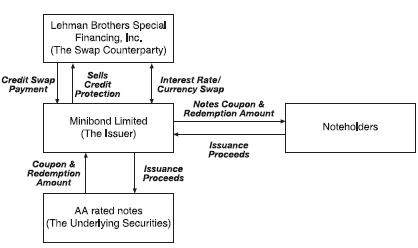
ReplyThe write up at the beginning of this discussion string on how MiniBond (using Series 2 as example) is one of the best summary I have seen – particularly with the diagram showing the various parties involved.
Here is a drill down question: Let’s say the Noteholders are getting 5%/year of payments as per the original design, how much of that comes from the AA rated underlying securities and how many of that 5% comes from Swap Counterparty?
In other words, now I know investors are both insurance company and underlying securities purchaser but just wonder which one carries more weight?
Keep in mind that those 6 reference entities carry pretty high credit ratings themselves. If you were one of their note purchaser, how much are you willing to pay for this insurance?
Putting it another way: let’s roll back the clock a couple of years back. If Lehman were to arrange an “Honest MiniBond” which only has the underlying securities and no Swap Counterparty, would people have bought (keep in mind that what are contained in the Underlying Securities were never disclosed. In other words the top box in the diagram does not exist. Do you think people would buy?
Love to get some insight from the experts in this string.
Thanks,
HK5D
ReplyHi HK5D,
The notes is structured to make money for Lehman, thus I would expect the cashflow from the underlying securities to be more than the coupon the investor gets.
ReplyYes, the first half of your statement is correct, i.e. Lehman makes money. The second half of your stmt also makes logical sense but depends on how much money the “insurance” part of the bond generates also.
I just did more research. At the beginning of 2007, the market price of a bond from one of the top 5 companies in SGX yields about 6.4% maturing 2010. How much the people who bought MiniBond Series 2 (which is US$ based also) got at that time? About 6.5% (I bought Sing$ one so I am just guessing and would welcome correction).
So, the obvious question was: two products being offered around the same time for around the same yield but the MiniBond has the risk of being an insurance company and also the underlying security credit ratings are probably lower. Why did people buy MiniBond? [I don’t know if I am making it more complicated because that Top5 Singapore company bond I hold was purchased in Hong Kong and I don’t know how easy it is to buy the same here.]
To cut it to the chase, what I am really interested in is: Lehman introduced the insurance componment into the design of a deceptive product like MiniBond not necessarily because of its contributes to higher yield also but without it, they would not be able to do that smoke and mirror magic of shfiting investor’s focus to the 6 big companies when they cannot even disclose the contents of the underlying securities!
Reply
Interesting comments from various ones. I was also a buyer of GE Choice (Aug 2013). Same story, the GE agent told me that it is a very safe product with defaults protection. However, with the recent financial tsunami, the only thing that is safe is cash in hand. Better think of a way to convince GE Life that I have been misrepresented by the agent – just in case the worst scenario happens – pray that it would not. An important lesson to learn – never buy into something that is so complex even the experts have difficulty understanding.
ReplyHi Steve,
I remember I read your post few days ago, you posted a link to show a internal letter of Lehman brothers or minibonds Ltd saying that some of the Reference Entities or the underlying securities have already been downgraded before Lehman’s bankcrupt. Can you show me the link again? Thank.

These are the underlying securities that are deemed defaulted:
1. Freddie Mac
2. Fannie Mae
3. Bear Stearns
4. Lehman Brothers

Hi Lioninvestor
I am a series 5 holder. saw your diagram illustrating the Swap counterpary’s role.
now that lehman (swap counterparty) is going to be bankrupt, will the minibond Ltd asset’s (underlying securities) be claimed by lehman’s creditors first? I should think not since typically swap arrangements are only contractual and not backed by assets.
can i clarify that basically, the noteholder’s role in this arrangement is to insure lehman against the default of the underlying securities.
Thanks
ReplyThe underlying securities should belong to noteholders. However, in the event of liquidation, there are some other parties that needs to be paid first – cost of unwinding, etc.
We insure lehman against default of the reference entities. The minibond is also a way for Lehman to package and sell their CDOs by making them the underlying securities.
ReplyHow to find all the names in the whole basket of the underlying securities? I cannot find it inside the prospectus.
ReplyI got it from Lehman Brothers previously.
HSBC Trust would probably know – but they are not releasing the information.
Reply

Latest new: HK Banks agree to buy back Lehman;s minibonds at market value
ReplyYesterday I received a call from Maybank, asked me to go to the bank next tuesday to have an interview. Did anyone have gone thru this kind of interview before? What do I expect them to say? Please share your experiences. Thank you.
Reply
Hello Fury
Their main focus is the sales process. Bring along your documents of the product. It will help you to recall better.
Reply
Hi Fury
I had received a call call from Maybank too my appointment on next Friday, she want to know more about the sales process.
Hi LM
Had you interview by Maybank? Can you share your experiences?
I hope that we can have same statment.
Hi Fury and LM,
My email address [email protected],

Tainted milk products are called back by the shops selling them.
They refund full price to the buyers. Minibonds were sold to individual investors much like the tainted milk products. The distributors have the obligation to refund full amount to investors.

Have invested $50000 in minibonds being told there were bonds. No one is getting in touch with me and feel desperate!!
Help!
Hi Mr Singh,
This might help:
http://www.martinlee.sg/how-to-file-a-dispute-for-structured-product-victims/
Reply
Hi.
Like to be in the loop as what is happening to this bad investment. Disappointed with our system.
ReplyHi Tiang Ho,
You might want to subscribe to the comments notification in the various posts related to Minibonds.
Reply
Pardon my ignorance. I am an unfortunate victim too.
What role does the reference entity have in this minibond arrangement?
We the investors are exposed to the underlying securities, not the reference entities. So why does Lehman Brothers special Financing have to pay premiums to insure themselves against default of reference entities? It would make more sense for them to insure themselves against default of the underlying securities….or?
ReplyMathew,
You have to consider Lehman as a separate entity from Minibond (and us).
Lehman Brothers pay Minibond a premium to insure themselves against default of the reference entities. There could be a few reasons:
1) They hold bonds of the reference entities.
2) They resell this insurance protection to others and make a profit.
3) It is easier to market the product using the names of the reference entities.
They don’t need any protection against default of the underlying securities as they have already transferred the risk to the retail investors who bought the minibond.
The minibond is setup in such a way that owners are exposed to both the reference entities and the underlying securities.
Reply
Hi lioninvestor,
Thanks but I still don’t quite understand about the picture and the layman explanation given. Where do those 5 or 6 BIG credit linked reference entities sit? In the underlying securities?
ReplyThe reference entities are the ones whereby Minibond sells credit protection on in return for the credit swap payment from Lehman Brothers.
In the event of a default by any of the reference entities, Minibond holders will have to swap their underlying securities for the bonds of the reference entity that had defaulted.
Reply
Hi folks, I havve been posting in another thread ‘ What Will Happen to my Lehman Minibond?’. I just notice there are some more victims here. Some of us from that thread have decided to meet up and take collective actions. If u are interested, please send your contact to [email protected]
Also Mr. Tan Kin Lian, ex-ceo of NTUC Income, has consulted a lawyer to look into possible legal action to help us. Please visit his blog at http://tankinlian.blogspot.com/2008/09/collective-action-on-credit-linked.html and submit your name and hp.
Reply
I bought thru maybank minibond series 2 and 3 with my hard earned money amt $70K. I have always invested in guaranteed capital. The officer dealt with us stated capital guaranteed but dividend may not. Also I have been made to understand that bonds are very low risk investment and also the brochures states clearly “invest in solid foundations” and the interest was 5%pa. Surely this cannot be a high risk investment. The booklet was only given us abt 3days later. I only took the trouble to read after being told by tel that my investment had gone sour and I may lose all my capital. I did not quite believe it until I call at maybank on monday and the officer confirmed it. Unlike insurance policy the agent will highlight to a policy holder the right to withdraw within 14 days of signing the policy,but not in this case. I am very disappointed that mas could allow such a product couched in devious term as a bond when it is not! Officers who sells such product must be accurate in their explanations to customers and not be concerned with making a quick commission! This is unethical.
Reply
Folks
Does anyone of you know what exactly the “underlying securities” are?
Are they securities issued by the credit-linked institutions (which is the better case) or are they issued by Lehman?
I read through the base propspectus and the pricing statement but seems it does not mention about it.
What I worry most is that those Underlying Securities are in fact issued by Lehman. I dont know if it is possible but let’s see this example.
Let’s say the 6 institutions issued corporate bonds, referred to as “A”. Lehman bought A, then issued bonds (“Lehman Bonds”) to Minibond Ltd. Minibond Ltd issue the minibonds, using the Lehman Bonds as Underlying Securities.
Ok, so A is basically held by Lehman, not Minibond, not HSBC. Minibond only holds Lehman Bonds. So now Lehman is bankrupt, and Lehman is default under Lehman Bonds. The worst case would be Lehman bonds is unsecured – meaning “A” was not used as collateral to issue Lehman Bonds. In that case, Minibond Ltd will have no recourse and get nothing, will then be bankrupt, and investors got nothing from minibonds as well.
So…what’s important is to know what the “Underlying Securities” are. Who issued them??? Anybody knows?
ReplyPhil,
They vary from series to series. The one I saw consisted of notes which were credit linked obligations of 100+ entities.
Someone mentioned that some series might have Lehman bonds as the underlying. I can’t confirm this.
http://www.martinlee.sg/what-will-happen-to-my-lehman-minibond/#comment-1711
Reply
My mom was a victim and she lost $50K of her savings which she saved over 20 years. She was told that the DBS high notes is very safe. She trusted the bank and lost everything. She was queuing up to deposit money into her bank account when she was targeted by the unscupulous marketers in the bank.
My mom has only primary 5 chinese education. She was a target because she was uneducated and could not possibly have understood the prospectus and what was communicated to her. I believe most victims are also older folks.
It is unlikely the authorities do anything because I believe they are part of the same gang. Until now MAS has remain silent when so many thousands have suffered the loss of their lifesavings. I believe the MAS and the Singapore will protect the bank from lawsuits, prosecution and proceed to silence the victims.
Reply
http://www.ft.com/cms/s/0/f472cb00-8806-11dd-b114-0000779fd18c.html?nclick_check=1
now that someone is taking over Lehman operations in Asia, are there hopes for Minibond afterall ?
Reply
Robin
I also have the same policy from GE.
I cannot find Goldman Sachs is mentined in any part of GE’s documents.
Just like to know what make you think that the “risks” are undertaken by Goldman Sachs?
ReplyCoffee-o,
Goldman Sachs is mentioned in the footnote of the fund report – you can find it in the Greatlink Funds Jan ~ June 2008 Report.
You could also get the pdf copy of the report at the following link –
http://www.lifeisgreat.com.sg/en/jsp/products/products/investment/fundreport.jsp
Select Greatlink Choice ( Dec 2013 )
ReplyRobin
Thank you.
I have found it, will go ask GE the remainding value of our Greatlink Choice? to see was it a greater choice over MINIBOMB? Or about the same class of BOMB.
Reply
Hi Coffee
My GE agent is a letdown. So far have not heard any update from him. Thinking of changing my agent.
Should we hold on to Greatlink Choice DEC 2013 till maturity. On the other hand, I am worried that 5 more years is ‘long’one.
Hi Gan
From the factsheet I received last week. GE claimed that the Greatlink Choice, a CDO product has better spread of reference entities in various industies and some “safety net” which can take on few more hits before it dies.
GLC (Dec 2013) is affected by the FB and FMs events, the current surrender price is at the range of 35% – 40% or less. It is someting like the possible value of minibond. I don’t see what so great of the GLC.
I will surrender it if I know how to make use of the little $ to do good stock pick when they are very cheap. If not, just hope that GE honours the coupons in every Dec till 2013.
It is a national disaster like the earthquake in China. Just glad that we are still alive and licking our own wounds.
Replycoffee-o and Robin,
I’m can’t determine how the Greatlink Choice is setup from just the factsheet. Certainly, there is some element of default risk that it undertakes…
Footnote 1 says:
Policyholders will have to hold their investments in the GreatLink Choice for the entire policy term of 7 years before they are eligible to receive the total payouts projected and 100% of their principal invested at maturity.
The next paragraph then says:
The annual payouts and return of principal invested are provided for by debt securities and derivative transactions employed as part of the investment approach of the funds and not backed by a guarantee. Policyholders may lose ALL OR PART OF THEIR INVESTMENT in the funds in the event there is a downgrade of the debt securities, default by the issuers of the debt securities, a default of the swap counterparty to the derivative transactions, an early redemption of the Note, or credit events resulting in cumulative losses that exceed the initial loss protection level. As such, no guarantee is given that policyholders will receive their principal invested at maturity or the payouts at each policy anniversary.
I have reproduced the historical fund price.
The market valuation (meaning if you surrender) of the Greatlink Choice ( Dec 2013) are as follows:
Sep 2008 – $0.352
Aug 2008 – $0.372
Jul 2008 – $0.391
Jun 2008 – $0.482
May 2008 – $0.390
Apr 2008 – $0.293
Mar 2008 – $0.426
Feb 2008 – $0.514
Jan 2008 – $0.680
Dec 2007 – $0.676
Oct 2007 – $0.843
Aug 2007 – $0.728
Jul 2007 – $0.979
Jun 2007 – $1.003
Jan 2007 – $0.945
It seems that it started going down since the subprime problem erupted. You might want to check with your GE rep whether the fund can still return 100% of your principal at maturity (based on the current valuation).
ReplyHi Lioninvestor,
My life planner is slow in getting me the summary of the fund! I looked through insurance policy, there is no details about how fund except for a listing of the 100+ reference entities.
There is a analysis of this product ( first tranche – 4 in total ) at the following link –
http://www.askdrmoney.com/Analysis_Structured_Bank_Products.htm
Is it correct for me to say that the GE product is similar in design to Minibond ?
If I am right, that means this is a High Risk Product under the current turbulent market conditions ???
ReplyRobin
It seems my GE’s advisor work harder. Today, he emailed all his customers an write-up on the Greatlink Choice by their internal expert.
Come with data and explaination on the LB and FM inpact on the various series of Greatlink Choice. Est. only less than 1%
Try to give double assurance that it is a better product than HN5 etc. Still 100% at maturity and coupon payments. But, today value is less then 50% of the orignal amount.
Try to get a copy from your GE’s advisor.
Can also share with you. if your advisor cannot give you.
ReplyMy take is that all these structured products issued by many companies are a time bomb waiting to explode.
If nothing happens, everyone is happy.
But if something happens, then we may see a repeat of the Minibond episode.
If you are not comfortable with your understanding of the product, check with your agent until he or she can explain to you fully (including all the risks of downside) – and document it in black and white carefully. You might need it one day.
In the event that a bomb does go off, at least GE would have a greater incentive to appease unhappy investors (and perhaps absorb the losses) as their reputation is at stake.
But then again, look at what’s happening to DBS High 5.
ReplyFund Price as at: 30-09-2008 (Monthly Valuation) Unit Price
GreatLink Choice (Sep 2010) 0.782
GreatLink Choice (Oct 2010) 0.779
GreatLink Choice (Aug 2013) 0.244
GreatLink Choice (Dec 2013) 0.210
GreatLink Choice (OCT 2012) 0.280
Gone down further due to market conditions in September.
ReplyIf the fund value keeps going down, say to a ridiculous value of 0.01, what will happen ?
If the fund loses 99% of its value, I would not think the Great Eastern could say with any conviction that –
“Annual payouts for Greatlink Choice will be made and principal will be repaid at maturity as long as the subordination level is not exceeded” ….. ? ”
This statement is found in the letter comparing Greatlink Choice to DBS High Note 5. The key message being that Greatlink Choice is different because there is “loss protection feature”!
ReplyRobin,
If the fund does reach 0.01, then there is a good chance the subordination level has been exceeded or is very close to being exceeded.
ReplyGood news for Greatlink Choice investors.
http://www.martinlee.sg/great-eastern-life-to-refund-greatlink-choice-investors/
ReplyThe debacle of Lehman Brothers made me investigate the Great Eastern GreatLink Choice in my portfolio which promised annual payout of 4.6%.
Apparently, the “risks” are undertaken by Goldman Sachs – which is in the same league as Lehman Brothers.
Does anybody know the implication should Goldman Sach goes under ?
ReplyRobin and coffee-o,
Perhaps you want to speak to your GE advisor for further
clarification?
If you can get me the pdf of the fund details, I don’t mind having a look at it too.
ReplyI have asked my life planner to clarify the basic question – is the GE product similar to Minibond.
The pdf file of the latest fund report can be found at –
http://www.lifeisgreat.com.sg/en/jsp/products/products/investment/fundreport.jsp
Select Greatlink Choice ( Dec 2013 )
ReplyHi Robin
What is your findings on the Greatlink Choice Dec 2013. There is another 5 year to its maturity and wonder if we should hold on to it.
My life planner sent me a GE letter which compared Greatlink Choice to DBS High Notes 5. It also stated that Lehman Brothers and Fannie Mae are two credit defaults but the “products ( the differen tranches ) were set up with a “loss protection feature” which allowed a number ( did not say how many for each tranche ) of credit events before the annual payout and maturity values are affected.
I asked for the product summary and reading the fine print, it is very complex and I can see the similarity with Minibond!
Reading today’s times – structured product is ranked #7 in terms of risk level and it is coded red. #1 is cash and #2 is bank deposit. When I purchased the GE 4.6%, I was under the impression that it is slightly more risky than fixed deposit!
If the ranking in the paper is correct, it is more risky than stocks! Unless there is something I don’t know which removed the risks as a Structured product – the “insurance” feature ???
The product looks very difficult to understand and current risk assessment is also tough – Reference Entities has seen 83 substitution ( there are only 119 in total ) ; 1 credit event ( it does not have Fannie Mae ) ; Rating has gone from AA to BBB+ ; Swap Counterparty is Goldman Sachs(!) ; The fund invested in notes issued by Signum Platinum Limited which nothing came up when I “googled”……
I am checking the current surrender value of my policy!
ReplyRobin,
Thanks for the update.
The market valuation of the Greatlink Choice ( Dec 2013) are as follows:
Sep 2008 – $0.352
Aug 2008 – $0.372
Jul 2008 – $0.391
I suspect it is even lower now after the carnage that occurred in September.
ReplyHi Robin
I have emailed to GE customer [email protected] – on 1 Oct and was told to wait for 3 working days.
At your end, have you heard anything from them and any idea do investor of GLC Dec 2013 make big huha. So far, I could not find any.
Thank you.
My life planner told me that I am the only client who keeps asking about this product’s risks. That gives me the impression that investors have not linked Greatlink Choice to Minibond/DBS High Notes 5.
The standard response I get is that the payout will continue as long as the number of credit default do not hit the set number. He has no answer as to why the valuation dropped so much but it should not affect payout. Payout is dependent on the # of credit defaults, the life planner kept stressing.
I am not comfortable with the answer but to get comfortable, I will have to understand the derivative jargon to order to ask intelligent questions!
I wonder if GE is obligated to disclose detailed information about their instrument if investors want to know…..
ReplyRobin,
The reason no one is asking is because very few people really track their single premium insurance purchases. And of course, even fewer knows its some kind of credit linked product.
If this item gets sufficient publicity, you can be sure everyone will be calling up their GE agent.
You can try asking them this question.
“How many defaults have been hit and how many more to go before the principle is affected? And if so, how would the redemption value be calculated?
Based on the current number of defaults, is the fund still on track to pay out 100% of principle upon maturity?”
Reply
Hi Lioninvestor,
Is Global Infrastructure exposure in US/Eurpe worth investing?
ReplyMat,
It’s hard to give an answer to your question in isolation.
Depending on the time horizon and investment objective, what is good for one investor might be bad for another.
ReplyDoes anyone has any clue what Minibond series 1, 2 and 3 securities are?
I called Philips Security and they also have no clue but still looking for answers. The exec try calling HSBC but was not able to reach them. Funny that that lioninvestor can but he cannot. I will write to him later and ask on update for the kind of securities the above minibond is tied to and will update everyone.
ReplyKenneth,
I have the list of securities for series 2. But that was before they swapped part of it.
I got it by asking one distributor to get it from Lehman Brothers a few months ago. They don’t usually release it to the public.
With Lehman Brothers not around anymore, can’t go that route.
But HSBC Trust would definitely know what they are.
Reply
Lioninvestor, thank for your clarification on the letter.
I have the series 2 and 3.
Last yr, I contacted Lehman Brothers to find out if the series is mortgage back securities or ABS. The reply from Lehman states that all the series securities are non-mortgage backed securities or ABS but corporate securities.
I don’t know whether if the new securities is better than the original securities.
Actually, the one to blame is Rating Agencies that rate the underlying securities fully aware that they are ill-liquid and have potential for default. Without them Lehman would not be able to market such toxic waste!
ReplyJohnson,
You might want to speak to MAS or consult a lawyer on whether you have any legal recourse.
Steve,
Thanks for posting for letter.
In layman terms, what the letter says is that on 15 Aug, Lehman substituted part of the underlying securities of minibond 1,2,3 with some other underlying securities.
They have the right to do it by the way. It’s mentioned in the prospectus. The Trustee is satisfied that the transfer is not materially prejudicial to the interests of the relevent Noteholders and has agreed to the substitution.
Well, we were not informed that this substitution took place and the notice is only sent out now. So, there was a delay somewhere.
ReplyLion Investor
Do they really have the right?
Under page 14 (FAQ) of the Pricing Statement:
Q: Can the underlying securities or swap arrangements be changed after
the issue of the Notes?
A: No, however…swap arrangements..
The “No” appears to me to mean that underlying securities cannot be changed after the issue of the Notes
Anyway, it may not really matter as we do not know whether the change is better or worst under current market conditions…
ReplyHi Foolish Investor,
According to what’s written in the letter, it’s covered under
“Notice is hereby given to the Holders of each Series of Notes in accordance with Condition 15 that, pursuant to Condition 4(e)of the Notes”
And I do remember reading something along that line in the documents.
Reply
Hi steve,
Your letter is dated 15 August 2008, before lehman brothers go bankrupt, not quite understand.
Reply
hate….. hate all this banker (the distributer). Everytime, you call them, they only tell you prepare for the worst. your money will be gone and that all!!!
Now, i can only get the latest update from this website and thank to this website.
ReplyJust received this letter from Minibond. Can anyone explain in plain language.
MINIBOND LIMITED
do Deutsche Bank (Cayman) Limited
P.O. BOX 1984, Boundary Hall
Cricket Square, George Town
Grand Cayman, KYI-1104
Cayman Islands
To: Holders of Notes
Cc: HSBC Institutional Trust Services (Singapore) Limited
21 Collyer Quay
#14-01
HSBC Building
Singapore 049320
(The Trustee, on behalf of the Holders of Notes)
Cc: The Hongkong and Shanghai Banking Corporation Limited
21 Collyer Quay
#14-01
HSBC Building
Singapore 049320
(The Issuing and Paying Agent)
Cc: The Hongkong and Shanghai Banking Corporation Limited
1 Queen’s Road Central
Hong Kong
(The Custodian)
Date: 15 August 2008
Minibond Limited (the “Issuer”)
Series 1, 2 and 3 (each a “Series” and together, the “Notes”)
issued under its Secured Note Programme
arranged by
Lehman Brothers Singapore Pte. Ltd.
Notice is hereby given to the Holders of each Series of Notes in accordance with Condition 15 that,
pursuant to Condition 4(e)of the Notes, the Issuer has substituted the Securities currently forming
part of th~ Mortgaged Property of each Series of Notes as set out in the column headed “Exist~
Securities in the Annex hereto with the securities set out in the column headed “New Securities in
the Annex hereto.
The New Securities have substantially the same terms as the Existing Securities except that the New
Securities shall be issued onl5 August 200~jthe “Settlement Date”) and will have the ISIN as set
out in the Annex hereto. The Existing Securities will be cancelled as of the Settlement Date with ~
accrued interest payable for the period from (and including) the Interest Payment Date (as defined in
the terms of the Existing Securities) immediately preceding the Settlement Date to the Settlement
..flate. For each Series of the New Securities, the Interest Acc~yal~f~ri~ (as defined in the terms of
the New Securities) in respect of the Interest Payment Date (as defined in the terms of the New
I
Securities) immediately following the Settlement Date (the “First Interest Payment Date”) shall begin
on (and including) the Interest Payment Date immediately preceding the Settlement Date (the
“Interest_Commencement Date”) an~endingon (but excluding) the First Interest Payment Date.
Upon issuance, the New Securities will have the same credit ratings as the Existing Securities as of
the Settlement Date. The Dealer will not be acting as dealer in respect of any series of the New
Securities.
As of the date of this notice, the New Securities shall become the Securities forrnin~p~2!jhe
Mortgaged Property of the relevant Series of Notes and be subject to the security created in favour of
the Trustee by the relevant Trust Deed. Based on the representations and warranties of the Issuer to
the Trustee relating to the substitution of the New Securities for the Existing Securities, the Trustee is
satisfied that such substitution is not materially prejudicial to the interests of the relevant Noteholders
and has agreed to such substitution. The Derivatives Counterparty has given its written consent to
such substitution.
Noteholders do not need to take any action in connection with the substitution of the Securities. If
Noteholders have any questions regarding their investment in the Notes, they are advised to contact
their Distributor.
Capitalised terms used in this notice but not defined herein shall have the meaning given to them in
the Conditions unless the context does not allow.

lioninvester, can we take legal against the distributors as what they told me is different from what is happening now.
ReplyHi Jasmine,
I owned Minibond Series 3.
Painful as it is, I am still blaming myself for getting into this mess. Again, even if I know the clause exist, I never once thought any of the reference entity will fail.
I guess the root of the problem is that we didn’t know the property bubble is about to blow in 2007 and minibond marketing had it that Lehman Minibond was selling like hot cakes in HK since 2003 with a series of awards. It was a good product that cannot fail. I went into it because the capital guranteed product has low return and worst still, came back recently with 99.1% of capital upon maturity as one of the bond was terminated in 2005 due to rating downgrade. [DBS StarTrack SGD]
My conclusion is hope for the best and prepare for the worst. Move on and don’t blame yourself too much.
ReplyJohnson
Read the “Pring Statement” as linked by lionionvestor
Page 20, and
Page 41, point (iv)
I can’t fault anyone for the fine-print…in fact, it’s not fine-print…it’s “info overload” in prospectus and pricing stt.
This event will change my views and approach towards risk management. I used to think that certain banks and insurers (e.g. AIG) are too big to fail, as the social consequences will be too huge. However, in today’s global financial system which is too inter-dependent, everything is possible. And even if there’s government bailout, currency will suffer.
Lioninvestor
Taking this chance, thanks and really appreciate the update on Minibonds. Like what someone mentioned earlier, we got more info more from here than from the distributors. What an irony.
ReplyWhen I bought the series 2, it was out of greed; paying 4.88%pa and those big banks were simply too big to fail. So it was a sure-stable and good deal.
Now I know the true colours of this deal.
Let us move on and take this as an important lesson learnt in our life.

but how to prove distributor has given you false information ??? is your words against their and vice versus….bank normally do not give u written assurance apart from what is on prospectus.
there is no warming news so far, hopefully MAS is now walking away from us..
ReplyThe time when i bought bonds i was told unless Reference entities go bankrupt, nothing will affect my investment. Now when things happen, is a different thing. Lioninvestor, is there a way we can take legal action against the distributors for the false information they have given me?
ReplyJohnson,
You can find links to the prospectus in my post above. There is a clause “if the swap arrangement is terminated for whatever reason”.
Foolish Investor,
Yes, in 2006, no one would have expected big banks to fail. We don’t know how the banks were evaluating the risks but certainly the retail investors won’t be aware.
But similar notes that were sold/bought after July 2007 were certainly a bad deal.
Kenneth,
You are welcome.
ReplyCan you sent me the old doc that show the product would be prematuredly terminated even if the “swap counterparty” (i.e. Lehmen) becomes insolvent! I bought minibond 7 and i cannot find any sentence on that.
Reply
When I bought Minibond Series 1 & 2 in 2006, I only focused on the reference entities. Only on this Monday (15 Sep) when I digged out the old doc that I realized that the product would be prematuredly terminated even if the “swap counterparty” (i.e. Lehmen) becomes insolvent!
Now that the features & risks of this product unveils, I finally realize how foolish the decision in 2006 was, in terms of risk (possible loss of entire principal) versus reward (<5% p.a.). Such product should never be created in the first place, let alone be marketed to retail investors!
But on the other hand, even if I were aware of this in 2006, who would have foreseen that Lehmen (and Citibank) would end up in such a state within two years?
Beginning to lose confidence…with banks and insurers…
I agree with a comment from another forum…”the banker is not your friend”…
ReplyHi,
Thanks for your prompt update. I am one of the owner and your website provides update-to-date information on the minibond situation. This helps to calm some nerve while I am preparing for the worst. Again, appreciate your input.
ReplyHi guys, did your financial manager told you will get affected when the arrangers go bankrupt? Cause mine told me i am exposed to the credit risk of the reference entities. Your full investment amount is at risk should any one of the reference entites experience a credit event. Lehman Brothers in this case is not even the reference entites? Why are we getting affected?
Reply
I faced the same problem too. I was only informed that as long as the 6 entities do not go bankrupt, I am SAFE. I just went to Hong Leong and the officer told me that the only thing she can help is to lodge a complaint to Fidrec. That’s all that I can do at this moment. The explanation that they give really sucks.
ReplyChris,
You have to lodge an official complaint to your FI first.
http://www.martinlee.sg/how-to-file-a-dispute-for-structured-product-victims/
Following which the FI has to meet the guidelines given by MAS:
ReplyYa. I did it today. I have lodged a complaint at hong leong main hq and they says they need abt 1 mth to give me a reply. Thereafter, if i am not satisfied about the outcome, i can request for further action through fidrec whom will then get the copy of complaint from hong leong. only till today that i know minibonds is not a bond. it is just a name of a company minibonds limited and i am not investing my money into bonds or the 6 entities listed but to securities which is of high risk. thank you for your info. indeed, i found out much over at this website than from anyone in the FI. Thanks
ReplyI was told same thing by maybank. It may be good idea for us similar cases to pool together should the need for legal action become necessary.
Reply
Hi Mr Png,
You mentioned that your case with Maybank about minibond has settled, can advise how it was settled? I also purchased my minibond from Maybank and do not know what to do till now.
Hope to hear from you.
Thank you.
Sam Lai
Hi Sam,
You can file a dispute.
Details here:
http://www.martinlee.sg/how-to-file-a-dispute-for-structured-product-victims/
Reply